

Katsuya Sake Brewery is a traditional Japanese sake brewery located in Munakata City, where Munakata Taisha Shrine, famous in Japanese mythology, is located.
It is also the origin of the sacred sake brewing on Okinoshima, a sacred island registered as a World Cultural Heritage Site, and uses sacred water from Nakatsumiya, Munakata Taisha Shrine, to brew sake.
This time, we will introduce Kazuhiro Tanaka, the brewer of Katsuya Sake Brewery!

Katsuya Sake Brewery Chief Brewer
Kazuhiro Tanaka Mr.
Tanaka chief brewer is from Sakai City, Osaka Prefecture. He is a wonderful brewer with a unique career history, having become interested in alcohol fermentation while working as a salesman for an automobile manufacturer, and before he knew it, he was producing alcohol for drinks instead of fuel.
Table of contents
- About Katsuya Sake Brewery
- About Okinoshima/Munakata Taisha Shrine
- About the relationship between the alcoholic beverage “Okinoshima” and the island where the gods reside “Okinoshima”
- About sake brewing in Munakata City
- How I got involved in sake brewing
- The most difficult thing about sake brewing and sake brewery management
- What made me most happy about sake brewing and sake brewery management?
- Thoughts and future vision behind sake brewing
- Finally
About Katsuya Sake Brewery

Katsuya Sake Brewery is located at the foot of Mt. Shiroyama, 369 meters above sea level, in Munakata City, Fukuoka Prefecture. In 1790, the founder Zenichi Yamamoto called himself Katsuya and began brewing sake using annual tax rice.
During the ``Chikuzen Bamboo Spear Uprising'' in 1886, the fourth generation head of the family, Yagoro Yamamoto, a mob broke into the brewery and the sake brewery was destroyed, forcing the company to suspend production.
However, generations of people have had great faith in Munakata Taisha Shrine, and thanks to that dedication, we have been able to continue producing sake in the current stable manner.
The name of the sake, ``Nara no Tsuyu,'' comes from the ``Nara Tree,'' a sacred tree at Munakata Taisha Shrine, and the monument erected to pledge eternal sake still stands next to the oak tree, telling the story of its history.
Although we are a small brewery with only a few brewers, we strive to produce quality sake using mineral-rich Shiroyama underground water. We have won many awards at competitions, including national competitions.
Additionally, in 2015, the main building and chimney were registered as national tangible cultural properties.
About Okinoshima/Munakata Taisha Shrine
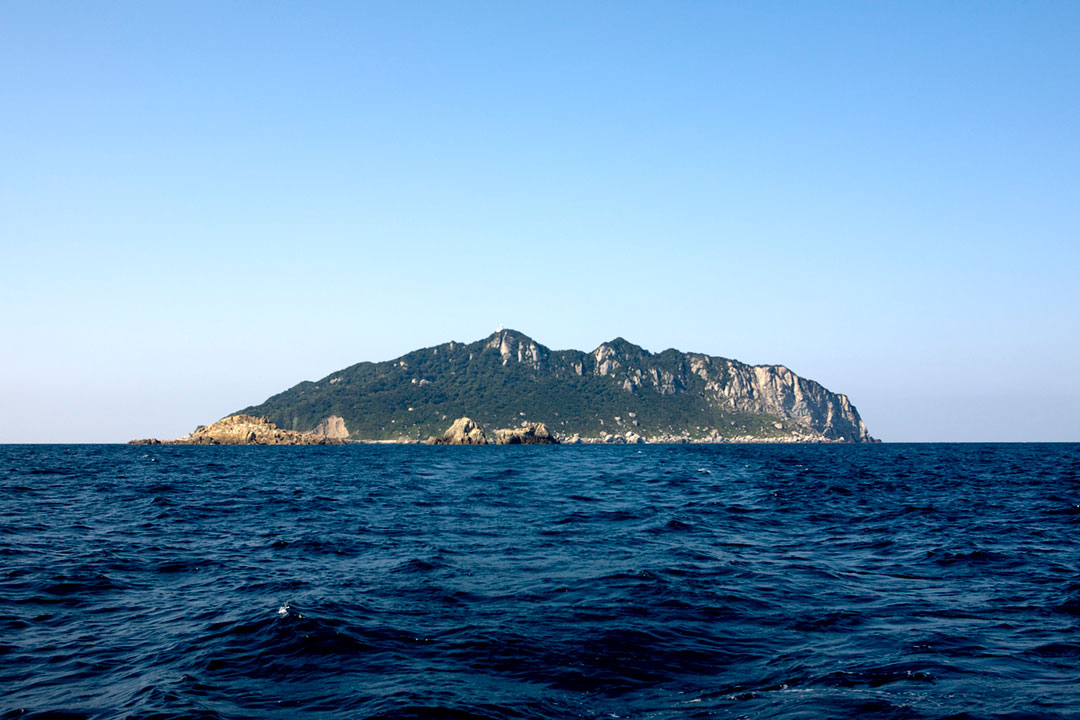
Image: Okinoshima (Source: Kyushu Travel Net)

Image: Munakata Taisha (Source: Tabirai)
Munakata Taisha Shrine enshrines the three mikokami of Amaterasu Omikami (Tashin Himekami at Okitsu-miya on Okinoshima, Tanatsu Hime-kami at Nakatsu-miya on Oshima, and Ichikishima Hime-kami at Hetsu-miya on Tajima).
These three shrines are collectively called Munakata Taisha. The area of Munakata is the closest to mainland China and the Korean Peninsula, and has been in an important position since ancient times as a window for foreign trade and receiving advanced culture.
In particular, Okinoshima, where Okitsu-miya is enshrined, is located almost in the center of the Genkai Sea, which connects Kyushu and the Korean Peninsula, and since the 4th century, rituals have been held to pray for safe voyages by offering various precious offerings.
The entire island is said to be an "island where the gods dwell" and is a place of worship, and due to various taboos such as strict restrictions on entry, it has remained exactly as it has been since ancient times.
About the relationship between the alcoholic beverage “Okinoshima” and the island where the gods reside “Okinoshima”

Okinoshima, the island where the gods dwell, was registered as a World Heritage Site in 2017, and its popularity quickly spread throughout the country.
Forty years ago, the company's president at the time received permission from the chief priest of Okinoshima and began producing sake with the Okinoshima name.
The sacred water of Nakatsumiya, Munakata Taisha Shrine, which is closely related to Okinoshima, is added to some of the water used to make Okinoshima, making it a very valuable sake.
It's so popular that parishioners fight over it at the dinner party called Naarai after the autumn festival (lol).
I think the reason it's so popular is because it goes well with seafood.
Seafood in Munakata has been famous since ancient times, and during the autumn festival, fishermen bring their own fish and wakame to the shrine.
If you are having a meal with them, you will prefer our Okinoshima.
As a side note, the Munakata wakame produced on the nearby Jijima Island is so delicious that it was presented to the imperial family, and is rich in flavor and high in nutrients.
If I were to describe a drink that goes well with such seafood in one word, it would be rich and dry.
We also produce sake that goes well with seafood such as yellowtail, horse mackerel, and blowfish.
This time, we are offering honjozo, junmai, and daiginjo from Okinoshima, but even with the same brand, the sake rice and manufacturing methods are slightly different, so you will experience completely different flavors.
About sake brewing in Munakata City
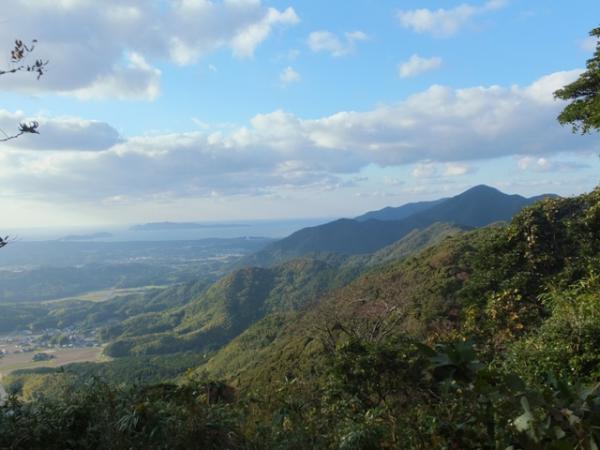
Image: Shiroyama (Source: Koichi Sanso)
Basically, we use underground water from Shiroyama for our brewing water.
Shiroyama's underground water is medium hard water, which I think is a little hard compared to Japanese water.
Also, since it contains a lot of calcium, the enzymes in koji dissolve well in water. This will help the rice dissolve more easily.
That's why it tends to be rich and dry.
Munakata's climate used to be as heavy as a snowy country in the past, but now there is no such thing and the weather is quite warm.
I think this is a story all over Kyushu, but due to the effects of global warming, it is difficult to keep the temperature down.
If the temperature gets too high, fermentation will occur too quickly, which is not good for sake brewing, so temperature control is also an important part of the brewer's job.
About how I started getting involved in sake brewing

I was originally interested in alcohol for fuel (lol)
Before entering vocational school, I worked at a dealership for the automobile manufacturer Suzuki, and at that time the price of gasoline had soared to around 200 yen per liter.
Because of this, I became interested in alcohol for fuel.
So, after that, I studied alcoholic fermentation at a vocational school.
Then, the twists and turns. Currently, we are producing sake, which is drinking alcohol rather than fuel alcohol. (lol)
It has been 10 years since I joined the company, and I trained under the previous chief brewer for five years, and became a chief brewer five years ago.
The most difficult thing about sake brewing and sake brewery management

After all, the rhythm of life becomes the rhythm of microorganisms.
Microorganisms don't sleep (lol)
Even now, I often stay overnight to make sake, and it's pretty tough when I'm in the middle of making sake.
Right now, I'm making various tools and improving them little by little so that I don't have to use them.
What made me happiest about sake brewing and sake brewery management?

After all, you can be the first to sample (evaluate your enjoyment of) the sake that comes out of the squeezer.
That is the most delicious!
It's a taste that can only be experienced by the people working at the production site.
Thoughts and future vision behind sake brewing
In the future, I would like to produce sake that is yeast-friendly.
The environment of sake mash is a very harsh environment for yeast.
This is because yeast normally live in an environment with oxygen, and an oxygen-free environment is very harsh.
Although alcohol is produced by yeast, yeast is actually weak against alcohol.
So when the alcohol content reaches around 14%, it starts to die.
Therefore, in the future, I would like to manage the yeast so that it does not die as much as possible and produce sake that is yeast-friendly.
We believe that by doing so, we can bring out the true taste of rice.
Finally
An online event will be held from 19:00 on Saturday, November 27th, with a special collaboration between the toji Tanaka introduced this time, the new president of Katsuya Sake Brewery, Mizui Yamamoto, and the manager of Green Grass, a bakery known to those in the know in Munakata!
We will deliver a set of 3 types of sacred sake dedicated to Okinoshima, the island where the gods dwell, together with garlic rusk, and toast together with sake fans from all over the country.
picture··! ? Garlic rusk in sake?
It's a surprising combination, but is it really delicious?
Please test it with your mouth!
1 comment
いつも道の駅宗像で購入させていただいてます。28日に宗像大社に行きますが勝屋酒造は開けられますでしょうか?