

[Direct account of the sake brewery president and chief brewer] What is sake made with flower yeast?
There are many different types of sake, and it's fun to choose one depending on your mood that day. When you say, ``I want to try sake that's different from what I usually do!'' or ``I want to try some rare sake,'' there are also times when you want to try it. However, many people may feel that they do not know what kind of things are out there.
In fact, I, myself, was once one of them...
So, let's make up our minds and ask the brewery president directly! We asked Kinoshita, the president of Amabuki Sake Brewery in Miyaki-cho, Saga Prefecture, about various things. President Kinoshita can be said to be the leading expert on sake breweries that use the famous and rare flower yeast!
It's really amazing to be able to hear this directly from the person himself.
This time, we learned more about flower yeast, such as ``What is flower yeast?'' and ``Characteristics of sake made with flower yeast.'' There are many types of flower yeast sake. After reading this article, you'll definitely fall in love with flower yeast sake.♪
Table of contents
- [Direct account of the sake brewery president and chief brewer] What is sake made with flower yeast?
- Toast directly with the sake brewery president and brewer♪ Hands-on local SAKE
- What is yeast?
- The secret story of the birth of flower yeast | Tokyo University of Agriculture Flower Yeast Research Group
- Types of flower yeast
- Characteristics of alcoholic beverages made with flower yeast
- List of sake breweries that use flower yeast
Toast directly with the sake brewery president and brewer♪ Hands-on local SAKE

We, who are writing this article, are running an in-home experience-based alcohol mail order service that combines "local alcohol mail order x online toasts with the makers."
It's a so-called online sake brewery tour, and it's a really nice service that allows you to toast with the presidents and brewers of local sake breweries from the comfort of your own home.♪
(→Don't say it yourself! lol)
We want you to experience not only the taste of the alcohol, but also the personality and way of thinking of the sake brewer.
We operate our services with this in mind.
The sake snack menu we will be introducing this time is a real recommendation that we heard directly from the online sake brewery tour.
What is yeast?
![What is the function of "yeast" in sake brewing? About the role and types of yeast | Sake Mizuki [Sawanotsuru Official]](https://www.sawanotsuru.co.jp/site/nihonshu-columm/wp-content/uploads/2018/12/8740-00046-1.jpg)
https://www.sawanotsuru.co.jp/site/nihonshu-columm/knowledge/nihonshu-yeast/
If you want to know more about Japanese sake, start with yeast! Yeast is a very important ingredient indispensable to sake brewing. First of all, let's understand the process of making sake and the role of yeast!
Are you curious about how sake is actually made? Broadly speaking, the work is progressing in eight steps. Let's look at the flow in detail.
| process | work | Description |
| 1 | Rice polishing | We use ``sake rice,'' rice specifically made for sake, and scrape off the unnecessary parts of the rice. |
| 2 | washed rice | Wash the polished rice thoroughly and let the rice absorb water. |
| 3 | steam | Steam the rice so that the koji mold can work more easily. |
| 4 | Koji making | Sprinkle koji mold on steamed rice and let it grow. |
| 5 | Shubo making | Steamed rice and yeast are added to the koji and fermented to create the liquid ``shubo'' that serves as the base for brewing sake. |
| 6 | Preparation | The process of transferring the mash mash to a large tank, also known as ``Moromi-zukuri.'' Add steamed rice, koji, and water separately in 3 parts. This process is also commonly referred to as "three-stage preparation." After fermenting for about a month, it becomes ``moromi''. |
| 7 | Squeezing, filtration, pasteurization | Pressure is applied to the mash to separate it into water (sake) and solids (sake lees). This is called "shibori". Then, impurities are removed through filtration. The sake is pasteurized at a low temperature of around 65 degrees Celsius, and at the same time, yeast activity is stopped to produce clear sake. |
| 8 | storage | The wine is slowly aged in tanks until it is shipped. |
Role of yeast
There are many types of yeast, and they are essential to the fermentation process. Yeast is widely used in miso, cheese, and bread, but the yeast used in sake brewing is called "sake yeast," and there are many different types.
Sake yeast has two major roles. By creating the important things that are essential to Japanese sake, these are "alcohol" and "aroma."
``Koji'' converts the starch in the rice into glucose, and ``yeast'' converts the glucose into nutrients and alcohol. During this alcoholic fermentation process, aromatic components are produced from the yeast, resulting in the sweet and gorgeous aroma unique to sake.
Since each yeast has different components, it is no exaggeration to say that the aroma and taste are determined by the yeast used. Therefore, yeast selection is a very important point.
What is flower yeast?
https://www.google.com/url?sa=i&url=https%3A%2F%2Fwww.amabuki.co.jp%2Fcommitment%2F&psig=AOvVaw3lilWWrDsgaPtWYhgh2INq&ust=1634187639726000&source=images&cd=vfe&ved=0CAwQjhxqFwoTCOjyrsPNxvMCFQAAAAAdAAAAABAD
Flower yeast was created from an innovative idea. Let us introduce you to the secrets behind its presence and charm!
Generally, many sake breweries use sake yeast isolated from the mash of sake. Meanwhile, flower yeast was born in the alcoholology laboratory of Tokyo University of Agriculture Junior College. The idea began when Professor Kubo Nakatada of the laboratory focused on the natural world after many years of research.
Professor Nakata established a method to isolate new sake yeast from nature. What's more, even in the natural world, where countless living things exist, he focused on flowers. At this time, we succeeded in isolating a unique yeast that produces aroma using flowers, which made sense as a natural yeast that brings out the flavor of sake.
Types of flower yeast
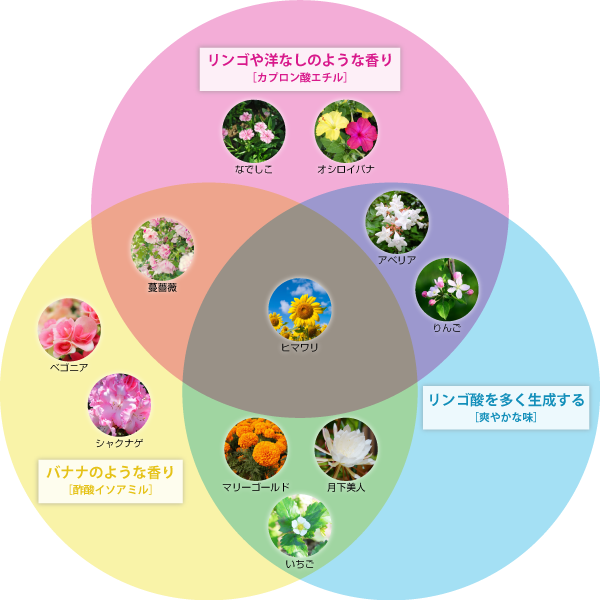
Yeast is closely related to the aroma of sake. Among them, there are various types of flowers that are the source of flower yeast. There are many examples, such as the following:
| yeast | Features |
| rhododendron | The sweet aroma and strong taste are just like bananas. |
| strawberry | Fresh acidity and sharp aftertaste |
| sunflower | Cool and refreshing flavor |
| Sakura | Rich and elegant aroma and refreshing taste |
| Dianthus | Fruity and rich taste like fruit wine |
| apple | A deep, sour taste with an apple aroma. |
| carnation | Taste that leaves a refreshing impression with a soft and refreshing flavor |
| cosmos | Distinctive flavor with added sharpness |
| Azalea | Sweet yet refreshing aftertaste |
| Abelia | Sweet and fresh aroma with a crisp aftertaste |
| Cattleya | Rich taste and elegant aroma |
| marigold | Elegant aroma and sharp taste |
| Begonia | A taste with a harmonious balance of depth and fruitiness |
| Vining rose yeast (Tsurubara) | Although it has an impactful flavor, it has a soft and refreshing scent. |
| Beauty under the moon | Refreshing on the throat, sharp acidity |
| daily grass | Smooth and timeless taste |
The name "flower yeast" gives the impression that it smells like flowers. What actually happens?
In fact, flower yeast can sometimes convey the scent of fruits that bear fruit, such as strawberry or apple blossoms, but in general, it is unlikely that you will be able to feel the scent of the flower itself, which is the source of the flower yeast.
Flower yeast exists to highlight the unique aroma, taste, and texture of sake, so the aroma and taste of sake will change depending on the raw materials and manufacturing method.
Furthermore, there are many types of flower yeast, so their aromas and tastes are diverse. Not only can you enjoy a rich variety of aromas, from heavy to light, and even more elegant and gorgeous, there are many aftertastes and textures that make drinking it enjoyable, and it is rich in individuality.
With so many varieties, you can enjoy finding your favorite flavor.♪
List of sake breweries that use flower yeast
There are many alcoholic drinks made with flower yeast all over the country! Introducing sake breweries across the country and the characteristics of their sake.
Source:Tokyo University of Agriculture Flower Yeast Research Group
| Hokkaido |
| There are no corresponding breweries. |
| east north | |||
| Okunomatsu Sake Brewery Co., Ltd. | Japanese sake | Fukushima | “Sweet Junmai” made with dianthus yeast |
| Rokkasen Co., Ltd. | Japanese sake | Yamagata | Rokkasen, Yamaboshi, Time and effort, Moment |
| Tenju Sake Brewery Co., Ltd. | Japanese sake | Akita | Junmai Daiginjo “Chōkaisan” (Nadeko yeast) |
| Akita Liquor Manufacturing Co., Ltd. | Japanese sake | Akita | |
| Hirota Sake Brewery | Japanese sake | Iwate | |
| Kanto | |||
| Seiun Sake Brewery Co., Ltd. | Japanese sake | Saitama | "Kankatsuyama" Honjozo Nadeshiko yeast preparation |
| Raifuku Sake Brewery Co., Ltd. | Japanese sake | Ibaraki | "Raifuku" Yamada Nishiki Junmai Ginjo Flower yeast brewed, and many others |
| Hakuso Sake Brewery Co., Ltd. | Sake/Shochu | Tochigi | "Tochiakane" Junmai Daiginjo brewed with vine rose yeast, and many others |
| Middle part | |||
| Tenryo Sake Brewery Co., Ltd. | Sake/Shochu | Gifu | "Hidahomare" Junmai Ginjo made with Nadeshiko yeast |
| Harada Sake Brewery | Japanese sake | Gifu | ``Dashi'' Junmai Ginjo, flower yeast brewed, and many others |
| Hirase Sake Brewery | Japanese sake | Gifu | Junmai Ginjo “Maruichiya” |
| Hara Sake Brewery | Japanese sake | Gifu | "Genbun" Sakura yeast preparation, and many others |
| Takenoi Sake Brewery Co., Ltd. | Sake/Shochu | Yamanashi | [Sake] “Seiko” “Takenoi”, [Shochu] “Yatsugatake no Mai”, “Blessings of the Sun and (Flower Yeast)” |
| Nishiida Sake Brewery Co., Ltd. | Japanese sake | Nagano | “Sekizen” and many others |
| Fukumitsuya Co., Ltd. | Japanese sake | Ishikawa | |
| Taiyo Sake Brewery Co., Ltd. | Japanese sake | Niigata Prefecture | Junmai Ginjo made with flower yeast “Taiyomori” |
| Kinki area | |||
| Tsubosaka Sake Brewery Co., Ltd. | Japanese sake | Hyogo | "Kagayaki" Junmai Ginjo |
| Ibaraki Sake Brewery LLC | Japanese sake | Hyogo | "Hananokura Abelia" Junmai Ginjo Abelia yeast brewed, and many others |
| Choryu Sake Brewery Co., Ltd. Koryo Kura | Sake/Shochu | Nara | "Gin no Kaoru" Rice shochu made with Abelia yeast |
| Sho Shiki Sake Brewery Co., Ltd. | Japanese sake | Shiga | "Urarahana" pure rice rhododendron yeast preparation |
| Ise Kadoya Beer | beer | Mie | Hanakin Himawari Sunflower yeast preparation
Hanakin Saison Apple yeast preparation |
| China country | |||
| Rihaku Sake Brewery Co., Ltd. | Japanese sake | Shimane | "Li Bai" Abelia yeast preparation |
| Okuizumo Sake Brewery Co., Ltd. | Japanese sake | Shimane | Nintamai Junmai Ginjo Flower yeast Abeliya yeast preparation |
| four countries | |||
| Kikusui Sake Brewery Co., Ltd. | Sake/Shochu | Kochi | |
| Kyushu | |||
| (Fund) Yoshidaya | Japanese sake | Nagasaki | “Mansho, Hanegi Shibori, Junmai Ginjo Sake” and many others |
| Harada Sake Brewery Co., Ltd. | (beer) | Nagasaki | |
| Shigeya Sake Brewery Co., Ltd. | Sake/Shochu | Nagasaki | |
| Amabuki Sake Brewery (fund) | Sake/Shochu | Saga | "Amabuki" and many others |
| (Investment) Takada Sake Brewery | Shochu | Kumamoto | “Asagiri no Hana” dianthus yeast preparation |
| Bungo Meijo Co., Ltd. | Shochu | Oita | |
| Okinawa |
| There are no corresponding breweries. |
Introducing a 3-bottle set where you can experience the different flavors of flower yeast "Amabuki Sake Brewery, Miyaki Town, Saga Prefecture"
We have explained the basic knowledge of flower yeast. Now that the question “What is flower yeast?” has been answered, let’s move on to the main topic!
This time, we will be introducing Amabuki Sake Brewery's recommended 3-bottle sake set, which we heard directly from Amabuki Sake Brewery President Kinoshita, Miyaki Town, Saga Prefecture.
About Amabuki Sake Brewery, Miyaki Town, Saga Prefecture

Amabuki Sake Brewery was founded in the first year of Genroku (1688) and is one of the oldest sake breweries in the world. The fertile soil is perfect for making sake rice, and the high-quality underground water flowing from the Sefuri Mountains. The brewery is located in the Saga Plain, which has an abundance of water that is so abundant that it gushes out of its own water.
Furthermore, the essence of Amabuki Sake Brewery is flower yeast. Sake brewed with flower yeast has a flavor unique to Amabuki Sake Brewery that cannot be produced anywhere else, and it embodies the soul and soul of our craftsmen who sincerely face both history and the future.
Representative brands are ``Amabuki Junmai Ginjo Sunflower Yeast,'' ``Amabuki Junmai Ginjo Strawberry Yeast,'' and ``Amabuki Kimoto Junmai Daiginjo Omachi.''
- Amabuki Sake Brewing Limited Partnership Company
- 2894 Higashio, Miyaki-cho, Miyaki-gun, Saga Prefecture
- TEL 0942-89-2001
- The homepage ishere
About President Kinoshita

President Kinoshita of Amabuki Sake Brewery is an accomplished person who studied brewing at the Department of Brewing at Tokyo University of Agriculture, the birthplace of flower yeast. It can be said that Amabuki Sake Brewery's strong brand power has been established because of its thorough knowledge of flower yeast.
When President Kinoshita returned from university, the company mainly shipped regular sake for the local market. In order to shift this to shipping outside of the prefecture, President Kinoshita has built a major brand through a new sake quality design.
The way he takes on new challenges while preserving tradition is pure passion. Even in his cheerful expression, you can get a glimpse of his passion for sake brewing. The company's brand, led by President Kinoshita, boasts gorgeous and beautiful brands.
Alcohol introduced this time
The three alcoholic beverages we will be introducing this time are: This is Amabuki Sake Brewery's representative brand.

Amabuki Kimoto Junmai Daiginjo Omachi 180ml
- Rice used: Omachi
- Rice polishing ratio: 40%
- Yeast used: Rhododendron
- Recommended way to drink: Chilled, room temperature, hot
Thoughts
A Junmai Daiginjo made from 40% Omachi rice. Carefully made using traditional techniques, the flavor of the rice is condensed and the quality of the rice stands out. The refreshing sourness is unique to Kimoto-zukuri. The unique and gorgeous aroma brewed with rhododendron yeast is sure to be felt no matter how you drink it, from cold to hot.
Junmai Ginjo Strawberry Cup Sake
- Rice used: Omachi
- Rice polishing ratio: 55%
- Yeast used: strawberry
- Recommended way to drink: Chilled, room temperature
Thoughts
This is a sake made with highly rare strawberry yeast. It is one of the representative brands brewed in combination with the Omachi rice used, and has a well-balanced combination of diverse characteristics. It has a clear sour taste and a fresh sweetness that is just like a strawberry and has a high value. It is a light drink with just the right amount of flavor.
Junmai Ginjo Himawari Cup Sake
- Rice used: Sake Komachi
- Rice polishing ratio: 55%
- Yeast used: sunflower
- Recommended way to drink: Chilled, room temperature
Thoughts
A dry Junmai Ginjo made from Akita Prefecture's "Sake Komachi" rice suitable for sake brewing and sunflower yeast. With a sharp and sharp aftertaste, this is a masterpiece that will make you feel the true value of a dry drink. We especially recommend the cold version, which is perfect for midsummer. Please enjoy the refreshing and good pulling quality.
I tried the pairing recommended by the sake brewery president to see if it really goes well.
I made all the sake pairing menus recommended by President Kinoshita and decided which one was the most delicious!
Is the result really interesting? ? w
Please take a look.
[You can experience the difference in flower yeast] Hands-on box from Amabuki Sake Brewery, Miyaki Town, Saga Prefecture

I want to actually experience this flower yeast! If you think so, please try it at home.♪
You can also purchase the ``Hands-on BOX,'' a set of three types of Amabuki Sake Brewery sake that we introduced this time, from below, so please be sure to purchase it.
Click here for Amabuki Sake Brewery's drinking comparison set "Hands-on BOX"
If you want to interact with the brewery president and brewer at home, try Hands-on Local SAKE
Each time we hold an event with a different sake brewery and a different theme related to sake, so if you are interested in the theme of this online sake brewery tour, please check it out below!